


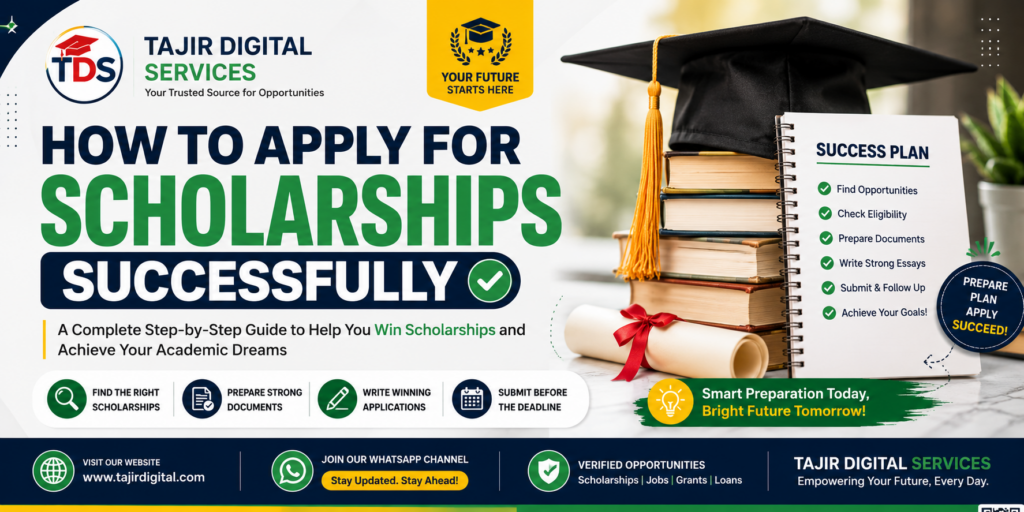
Learn how to apply for scholarships successfully with this complete step-by-step guide. Discover where to find genuine scholarships, document preparation tips, and expert advice.
Winning a scholarship can significantly reduce the financial burden of education and open doors to incredible opportunities at some of the world’s best universities. Every year, thousands of scholarships are offered by governments, universities, private organizations, and international foundations. However, many applicants miss out because they submit incomplete applications, fail to meet eligibility requirements, or make avoidable mistakes.
This comprehensive guide will walk you through every stage of the scholarship application process—from finding legitimate scholarships to submitting a strong application that increases your chances of success.
Whether you are applying for an undergraduate, master’s, PhD, or professional scholarship, this guide will help you prepare effectively.
Table of Contents
- What is a Scholarship?
- Types of Scholarships
- How to Find Genuine Scholarships
- Understand the Eligibility Requirements
- Prepare Your Documents
- Write a Strong Personal Statement
- Get Excellent Recommendation Letters
- Complete the Application Carefully
- Submit Before the Deadline
- Prepare for Scholarship Interviews
- Common Mistakes to Avoid
- Final Checklist Before Submission
- Frequently Asked Questions
- Conclusion
A scholarship is financial assistance awarded to students to support their education. Unlike loans, scholarships generally do not need to be repaid.
Depending on the provider, scholarships may cover:
- Full Tuition Fees
- Partial Tuition Fees
- Accommodation & Housing
- Monthly Stipends & Living Expenses
- Travel & Airfare Costs
- Health Insurance
- Books, Equipment, and Research Costs
There are several types of scholarships available, depending on your background and achievements:
- Merit-Based Scholarships: Awarded to students with excellent academic performance, high test scores, or outstanding extracurricular achievements.
- Need-Based Scholarships: Designed specifically for students who demonstrate financial need.
- Government Scholarships: Funded by national governments to support education locally or internationally. Notable examples include:
- Chevening Scholarship (UK)
- MEXT Scholarship (Japan)
- CSC Scholarship (China)
- University Scholarships: Offered directly by universities to attract highly talented international students to their campus.
- Private Organization Scholarships: Sponsored by corporate companies, charities, and non-governmental organizations (NGOs).
With so many scholarship offers on the internet, it is crucial to use trusted sources to avoid scams. Reliable places to search include:
- Official University Websites (usually under the “Admissions” or “Funding” tabs)
- Government Scholarship Portals
- Embassy Websites of your target study countries
- International Organizations (like the UN, Commonwealth, etc.)
- Tajir Digital Services (your trusted, verified hub for scholarship updates)
⚠️ Red Flag Warning: Always avoid websites or agencies that ask you to make a payment before allowing you to apply. Legitimate scholarship applications are almost always 100% free.
Before spending hours on an application, carefully read the scholarship eligibility criteria. Double-check the following parameters:
- Nationality: Is your country on the list of eligible nations?
- Age Limits: Does the scholarship have a strict age cutoff?
- Academic Qualifications: Do you hold the required GPA or class degree? (e.g., First Class or Second Class Upper)
- English Language Requirements: Do you need IELTS, TOEFL, or is an English Proficiency Letter from your previous university accepted?
- Work Experience: Is professional experience required? (Common for master’s programs like Chevening).
Rule of thumb: Never apply for scholarships if you do not meet their mandatory eligibility criteria. Focus your energy on opportunities where you fit the profile perfectly.
Most scholarship applications require a standard set of professional documents. You should prepare these well in advance:
- Academic Certificates & Transcripts
- International Passport (must be valid)
- Curriculum Vitae (CV) / Resume
- Statement of Purpose (SOP) / Personal Statement
- Academic & Professional Recommendation Letters
- English Language Test Results (if applicable)
- Passport Photographs
💡 Pro-Tip: Create a dedicated folder on your computer or cloud storage (like Google Drive) containing clean, high-quality PDF and scanned copies of all these documents. Name them clearly (e.g.,
Abdulrazak_Academic_Transcript.pdf).
Your personal statement (or Statement of Purpose) is your chance to stand out from thousands of other applicants. It should clearly and convincingly explain:
- Who you are and what drives you.
- Your academic background and key achievements.
- Your short-term and long-term career goals.
- Why you deserve this specific scholarship.
- How the scholarship will benefit your community or country when you return.
Remember: Be authentic, write from the heart, and never copy personal statements from the internet. Plagiarism is an instant rejection.
Recommendation letters add credibility to your application. Choose referees who actually know you well and can speak highly of your abilities, such as:
- University Lecturers or Professors
- Academic Advisors
- Work Supervisors or Employers
Always give your referees at least 2 to 3 weeks’ notice before the deadline so they have enough time to write a thoughtful, high-quality letter for you.
When filling out the online application portal:
- Double-check every detail: Make sure your names match the exact spelling and order on your official international passport.
- Upload correct files: Ensure you don’t accidentally upload a draft version of your SOP or the wrong transcript.
- Proofread: Review your answers for spelling, punctuation, and grammatical errors.
Do not wait until the final hours to click submit. Scholarship portals often crash on the deadline day due to massive traffic from applicants worldwide. Aim to submit your application at least 3 to 5 days before the official deadline to avoid unexpected technical glitches.
If you are shortlisted, many top-tier scholarship providers will invite you for an interview. Prepare effectively by:
- Researching the sponsor: Understand the scholarship’s mission and values.
- Practicing common questions: Be ready to talk about your goals, leadership experiences, and why you chose your specific course.
- Testing your setup: For video interviews, ensure you have a quiet room, a stable internet connection, and clean lighting.
- Dressing professionally: Dress the part, speak clearly, and project confidence.
- ❌ Missing the deadline.
- ❌ Uploading incorrect or poorly scanned documents.
- ❌ Applying without verifying the eligibility criteria first.
- ❌ Copying or plagiarizing personal statements.
- ❌ Using unverified or fake academic certificates.
- ❌ Ignoring specific application formatting instructions.
- ❌ Submitting incomplete application forms.
Before clicking Submit, confirm that you have checked off every item on this list:
- [ ] Read and met all eligibility requirements.
- [ ] Completed every section of the online application form.
- [ ] Uploaded all required, correctly named documents.
- [ ] Proofread your application and essays for spelling and grammar.
- [ ] Verified your email and phone contact details are correct.
- [ ] Submitted ahead of the final deadline rush.
Can I apply for multiple scholarships at once?
Yes, absolutely. In fact, we highly recommend it. Applying for multiple scholarships increases your chances of securing funding. Just make sure to tailor each application specifically to the scholarship provider.
Do all scholarships require IELTS?
No. Many universities and scholarship boards waive IELTS requirements if your previous degree was taught entirely in English. You can often present an English Proficiency Letter from your previous institution instead.
Is it completely free to apply?
Yes. Almost all legitimate, fully funded scholarships (like Chevening, MEXT, MasterCard Foundation, etc.) are 100% free to apply. Never pay an agency or website promising to “sell” you a scholarship.
Can I edit my application after I have submitted it?
This depends entirely on the scholarship provider. Some online portals allow updates right up until the deadline, while others lock your application the moment you click submit. Always assume you cannot edit it, and review everything thoroughly beforehand!
Applying for scholarships successfully requires careful preparation, strict attention to detail, and persistence. By following the steps outlined in this guide, you will dramatically improve the quality of your applications and increase your chances of securing life-changing funding for your education.
Every single successful scholarship recipient started exactly where you are today—with a single application. Stay organized, apply early, and keep improving your application materials with each new opportunity. Good luck!